A faded fire lane is easy to ignore right up until an inspector flags it, a tenant complains, or emergency access gets slowed at the worst possible time. Fire lane striping requirements are not just about paint on pavement. For commercial properties, they affect life safety, day-to-day traffic flow, code compliance, and liability exposure.
If you manage a retail center, medical office, industrial site, apartment complex, or mixed-use property, fire lane markings need to be treated as part of the building’s safety system. They have to be visible, placed correctly, and maintained over time. That sounds straightforward, but in practice, the details can vary by municipality, fire marshal, and site layout.
What fire lane striping requirements are really trying to accomplish
At the most basic level, a fire lane exists to keep critical access clear for emergency vehicles. That means the striping has one job above all else: make it obvious where parking or standing is prohibited so responders can get where they need to go without delay.
For property owners and managers, that purpose matters because it changes how the work should be approached. Fire lane markings are not decorative and they are not the same as general curb painting. They need to be legible from a distance, understandable to drivers in motion, and durable enough to hold up under traffic, weather, and regular wear.
On busy properties, that often means pairing painted curbs with pavement stenciling and, in some cases, signs. A curb alone may not be enough if the site is large, visibility is limited, or local enforcement expects more explicit marking. The right combination depends on the property, but the standard should always be the same: no confusion.
Why fire lane striping requirements can vary by location
This is where many property teams run into trouble. They assume there is one universal standard for every site. There are common practices, but actual fire lane striping requirements can differ based on local code interpretation, fire department guidance, and the conditions of the property itself.
In the Houston area, different cities and jurisdictions may have their own expectations for wording, curb color, letter height, spacing, and whether signage is required in addition to striping. A shopping center in Katy may not be treated exactly the same as a facility in Pearland or Tomball. Even within the same market, an older property undergoing updates may face different practical issues than a newly built site.
That is why a field-based approach matters. Before restriping begins, the site should be reviewed for current markings, curb condition, traffic patterns, and any known fire marshal requirements. Guessing from a photo or copying the lot next door is how properties end up paying twice.
The markings that usually matter most
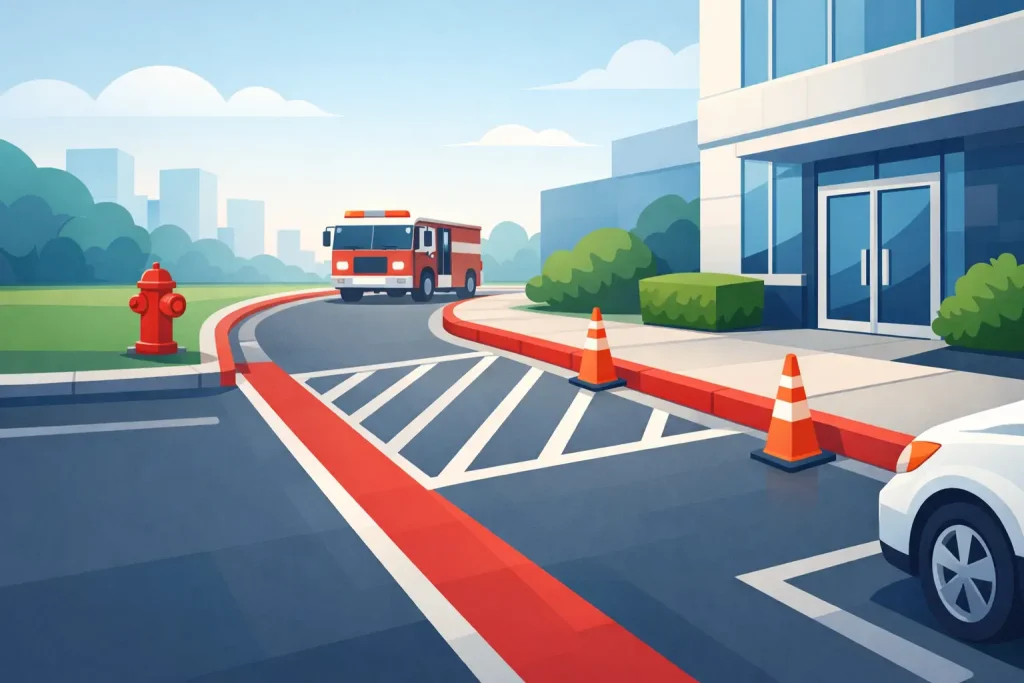
Most fire lanes rely on a few core visual elements: red curb paint or other designated curb marking, clearly stenciled wording such as FIRE LANE or NO PARKING FIRE LANE, and placement that follows the approved access route. In some cases, directional arrows or supplemental markings may also be needed to reinforce no-parking zones around turns, loading areas, or building fronts.
The exact wording is not always the same everywhere, which is one reason precision matters. If a local authority expects specific language and the site uses a shortened or nonstandard version, the lane may still be considered deficient. The same goes for letter size and spacing. If the message cannot be read clearly by approaching drivers, the striping is not doing its job.
Color matters too, but not in a casual sense. Fire lane curbs are commonly painted red because drivers recognize the meaning quickly. If that paint is sun-faded, patchy, or buried under layers of dirt and tire wear, visibility drops fast. In Houston’s climate, UV exposure and heavy rain can shorten the life of lower-quality materials, so product choice has a direct effect on performance.
Common property mistakes that create risk
The most common problem is simple neglect. Fire lane markings fade gradually, so they rarely trigger action until they are already hard to read. By that point, the property may be exposed to complaints, failed inspections, or confusion during peak traffic.
Another issue is partial repainting without a full plan. A crew may refresh curb color but skip stencils, or repaint one section while leaving mismatched markings elsewhere. That creates an inconsistent message across the site. Drivers notice inconsistency more than property teams expect, especially in high-traffic commercial environments.
There is also the problem of layout drift. Over time, spaces get added, curbs get repaired, loading activity changes, and traffic patterns shift. If parking stalls begin creeping too close to designated emergency access areas, the fire lane can become compromised even if the words are still visible. In those cases, striping is not just a maintenance task. It becomes a layout correction.
How to approach compliance without overcomplicating it
The safest approach is to treat fire lane work as a coordinated site review, not a quick paint order. Start by identifying which areas are intended or designated as fire lanes, then compare current markings against site conditions and local expectations. That includes looking at curb color, pavement wording, spacing, approach visibility, and any related signage.
From there, the practical questions are straightforward. Are the markings readable from a vehicle? Are they placed often enough to avoid ambiguity? Do they match what the local authority expects to see? Has weathering reduced visibility to the point that the lane is no longer clearly enforceable?
If the answer to any of those is uncertain, it is time for a closer look. A disciplined contractor will not just repaint what is already there without asking whether it is still correct. They should walk the property, flag problem areas, and explain what needs to be refreshed, corrected, or coordinated before work begins.
Fire lane striping requirements and active commercial properties
On an occupied property, the job is not only about compliance. It is also about getting the work done with minimal disruption. Medical offices, retail centers, warehouses, and multi-tenant sites cannot always shut down large sections of vehicle access during business hours.
That is why scheduling matters almost as much as workmanship. Fire lane restriping often needs to be phased so access stays open while markings are restored section by section. The crew should understand traffic flow, tenant operations, delivery activity, and cure times for the chosen materials.
This is one of those areas where experience shows. A technically correct striping plan can still create operational headaches if it blocks entrances at the wrong time or leaves drivers without clear routing during the project. The best results come from planning the site as it actually functions, not as it looks on paper.
When restriping is enough and when redesign is needed
Sometimes the fix is straightforward. If the fire lane layout is already correct and the markings are simply worn down, restriping and curb repainting may be all that is needed. That is a maintenance project.
Other times, the visible wear points to a deeper issue. If vehicles regularly stop in the lane, turning movements are tight, or parking encroaches on access zones, the property may need more than fresh paint. It may need revised stall lines, better directional markings, added signage, or adjustments to the overall traffic pattern.
That distinction matters because repainting a flawed layout only gives a clean look to an ongoing problem. A good site review should separate cosmetic refresh work from true safety corrections.
What property managers should expect from a striping partner
You should expect clear answers, not vague promises. That means a site walk, a scope that explains what will be marked and why, durable materials suited for local conditions, and a plan for completing the work without unnecessary downtime.
You should also expect some honesty about gray areas. Not every site has the same enforcement history or municipal standard, and sometimes the right answer is to verify a detail before paint goes down. That is not hesitation. That is doing the job right the first time.
For Houston-area properties, a contractor who understands local operating conditions can make the process much easier. Five Alarm Striping approaches fire lane work the same way it approaches the rest of a lot: with clear planning, code-conscious execution, and a focus on keeping the site safe, functional, and easy to navigate.
A clean red curb and crisp stencil send a simple message, but they carry real weight. When fire lane markings are visible, accurate, and maintained, they help protect people, support emergency access, and give property teams one less preventable problem to worry about.