A parking lot usually tells on itself within the first five minutes. Cars stack up at one entrance while another sits underused. Delivery vans cut across parking aisles meant for shoppers. Pedestrians walk in traffic lanes because the marked path is faded or missing. If you are asking how to improve parking lot traffic flow, the answer usually starts with something simple – your lot is communicating poorly.
Most traffic problems in commercial lots are not caused by reckless drivers. They come from unclear direction, worn markings, bad aisle widths, poor stall angles, misplaced access points, and circulation patterns that no longer match how the property is actually used. A parking lot can look busy and still work well, but it has to be laid out with purpose.
How to Improve Parking Lot Traffic Flow at the Layout Level
The biggest gains usually come from the overall layout, not from one extra arrow or a few fresh lines. If vehicles are entering, parking, backing out, and exiting in ways that conflict with each other, the lot needs more than cosmetic touch-ups.
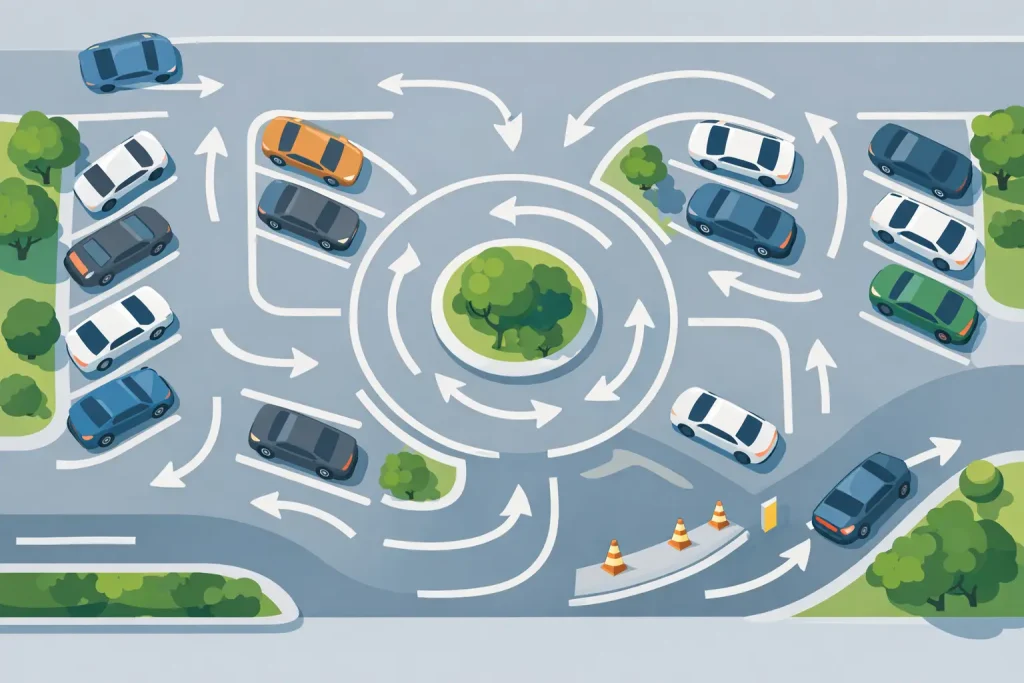
Start with entry and exit behavior. Drivers should be able to tell where to go as soon as they pull in. If the first decision point is confusing, congestion spreads fast. Two-way drive lanes often make sense in larger fields of parking, but in tighter lots, one-way circulation can reduce hesitation and backing conflicts. The trade-off is capacity. One-way aisles may improve movement, but they can also require more deliberate stall planning.
Parking angle matters more than many owners expect. Ninety-degree spaces can maximize stall count, but they ask more of the driver when backing out, especially in busy retail or medical settings. Angled parking often improves circulation because it supports a more natural one-way pattern and makes parking easier. That said, it is not right for every property. Industrial sites, service yards, and facilities with larger vehicles may need a different balance between efficiency and maneuvering room.
Aisle width is another common problem. If lanes are too narrow for the vehicle mix using the property, traffic slows down and small conflicts turn into bottlenecks. This shows up often when a lot was originally designed for passenger cars but now sees regular box trucks, work vans, or heavy service traffic. In that case, restriping alone may not fix the issue unless the layout is adjusted to reflect current use.
Watch the Conflict Points First
If you want to know how to improve parking lot traffic flow without guessing, pay attention to where movement breaks down. The trouble spots usually repeat themselves every day.
Entrances and exits are the first place to look. If inbound traffic queues into the street or outbound vehicles struggle to turn safely, the approach geometry, lane markings, or directional signs may be off. Sometimes the issue is not the driveway itself but what happens 30 feet inside it. A cross aisle, stop bar, or first row of parking may be creating a choke point right where vehicles need space to sort themselves out.
Pedestrian crossings are another major factor. People will take the shortest path, whether it is marked or not. If the walkway is inconvenient, faded, or disconnected from entrances, they end up walking through active drive lanes. That is a safety issue first, but it also affects flow because drivers become unpredictable when pedestrians appear where they are not expected.
Loading zones, pickup areas, and fire lanes need special attention. These are high-risk zones for traffic disruption because they attract stopping, standing, and turning movements in places that need to stay clear. When markings are faded or the intent is not obvious, drivers improvise. Improvisation is the enemy of smooth circulation.
Striping and Markings Do More Than Make a Lot Look Clean
Fresh striping helps because it removes doubt. Drivers react faster when the information is clear. That means visible stall lines, crisp directional arrows, stop bars, crosswalks, painted curbs, and no-parking zones that are easy to understand at a glance.
This is where many properties fall behind. Owners often wait until markings are badly faded, then wonder why the lot feels disorderly. By that point, drivers have already developed bad habits. They park over lines, cut through open areas, ignore circulation intent, and block corners because nothing on the pavement clearly tells them otherwise.
Good striping should match the site’s real operating pattern. If tenants changed, traffic volume increased, or a portion of the property was repurposed, the old layout may no longer fit. Re-striping is the right time to correct spacing, improve directional logic, and clean up problem zones instead of just repainting the same mistakes.
In Houston-area properties, durability matters too. Heat, rain, traffic wear, and UV exposure all shorten the life of pavement markings. Materials and scheduling should reflect local conditions so the work stays visible and serviceable, not just fresh for a few weeks.
Signage, ADA Access, and Fire Lanes Need to Work Together
A lot with good striping can still fail if signs and regulated areas are handled poorly. Drivers need consistent guidance from curb to pavement to building entrance.
ADA spaces and access aisles must be properly marked and placed, but they also need to fit the traffic pattern around them. When accessible stalls are squeezed into awkward locations or surrounded by conflicting vehicle movement, compliance may exist on paper while usability suffers in practice. The same goes for pedestrian access routes. They should be direct, visible, and protected from unnecessary crossing conflicts.
Fire lanes are another area where traffic flow and compliance overlap. If a fire lane is not clearly marked, it often becomes a temporary standing area for pickups, short-term parking, or overflow. That creates both a life-safety issue and a circulation problem. Clear curb painting, pavement markings, and supporting site planning help keep these areas open and understandable.
Signage should support the pavement plan, not compete with it. Too little signage leaves drivers guessing. Too much creates clutter that people ignore. The best setups use signs where a driver needs an early decision and pavement markings where the driver needs immediate confirmation.
Match the Parking Lot to the Property Type
There is no one-size-fits-all answer for how to improve parking lot traffic flow because each property has different pressure points.
Retail centers need circulation that feels intuitive and quick. Customers want short walks, easy turns, and clear exits. Medical properties need stronger pedestrian protection and more forgiving layouts because many visitors are elderly, distracted, or unfamiliar with the site. Industrial facilities often need to separate employee parking from truck movement and service access. Office properties may deal with sharp peaks during arrival and dismissal times rather than steady all-day volume.
That is why site walks matter. A layout that looks fine on paper can still fail in real use if the vehicle mix, tenant behavior, or delivery schedule was not considered. Watching how a lot actually operates often reveals the fix faster than reviewing an old plan set.
When a Restriping Project Should Include a Redesign
Sometimes a parking lot only needs refreshed markings. Other times, repainting the same lines is money spent without solving the problem.
A redesign is usually worth considering when drivers regularly ignore the intended pattern, stalls are consistently blocked or underused, pedestrian paths are unclear, or vehicles back into active lanes with limited visibility. It is also smart to reassess the layout when ownership changes, major tenants turn over, or the property has added new traffic demands such as curbside pickup, delivery staging, or increased van traffic.
This is where a disciplined contractor adds value. The right team does not just ask what needs paint. They ask how the site functions, where liability is building, and what changes will reduce confusion without disrupting operations more than necessary. That practical planning is what keeps a project from becoming a patch job.
For many Houston-area properties, the best results come from a phased approach. Correct the circulation issues, refresh the striping, update ADA and fire lane markings, and coordinate the work around active business hours. That minimizes downtime while still improving the lot in a meaningful way.
Five Alarm Striping approaches projects with that kind of field-first mindset – clear planning, code-conscious execution, and work that is meant to hold up under real traffic.
The Best Improvements Are Usually the Clearest Ones
Property owners do not need a flashy parking lot. They need one that makes sense the first time a driver enters it. Clear lanes, readable markings, logical stall layout, protected walkways, and properly marked regulated areas all work together to reduce hesitation and conflict.
If your lot feels chaotic, the fix is rarely more enforcement alone. Most of the time, drivers are responding to mixed signals or no signals at all. Clean that up, and traffic starts moving the way it should.
A well-marked lot does more than move cars faster. It helps people arrive, park, walk, and leave with less friction, which is exactly what a commercial property should do every day.