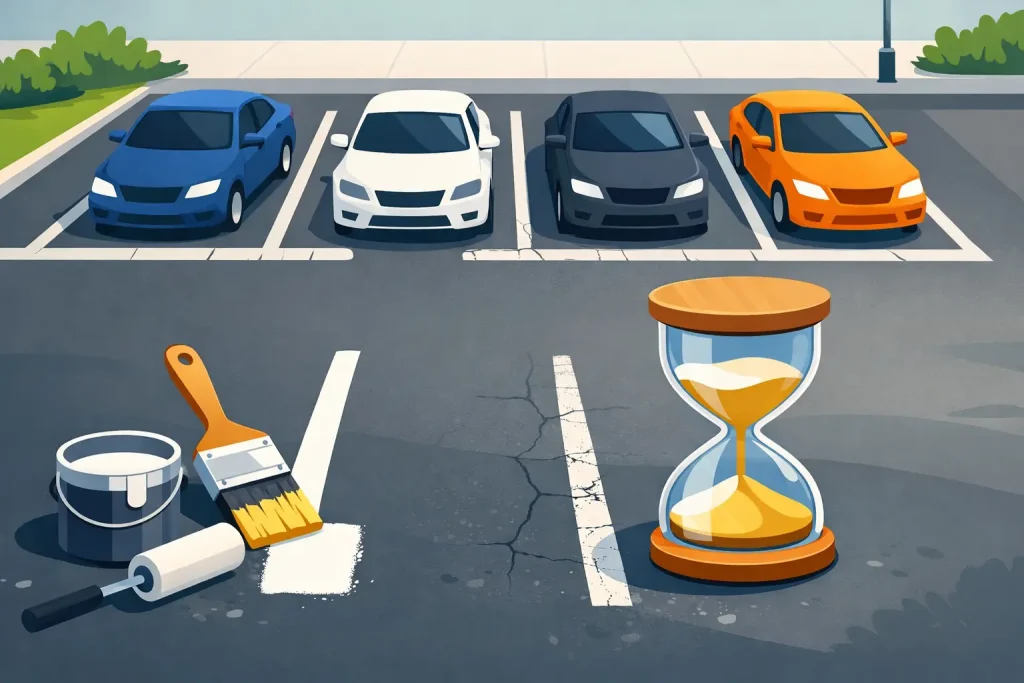
Fresh striping can make a property look sharp overnight. But for commercial owners and managers, the real question is not how it looks on day one. It is how long does parking lot paint last once traffic, heat, rain, oil, and routine wear start working on it.
The honest answer is that most parking lot paint lasts about 12 to 24 months before it needs noticeable touch-up or full restriping. On some properties, it can start fading sooner. On others, well-applied markings in lower-traffic areas can hold up longer. The difference usually comes down to traffic volume, surface condition, material choice, and local weather.
For Houston-area properties, that timeline tends to be shaped by a hard mix of sun exposure, heavy rains, humidity, and active vehicle use. If your lot serves retail traffic, delivery vehicles, medical tenants, or industrial operations, striping life is rarely just a question of age. It is a question of visibility, safety, and whether the markings still do the job they were meant to do.
How long does parking lot paint last in real conditions?
If you are looking for a quick planning number, use one to two years for standard parking lot striping. That is a practical benchmark for budgeting and maintenance scheduling.
But real-world performance is not uniform across a site. Stall lines near storefronts often wear faster than rows with lighter use. Entry arrows, stop bars, and fire lane markings usually take more abuse than standard striping because they sit in turning paths, braking zones, and high-friction areas. ADA symbols and hatch marks also need to stay crisp, which means they may need attention sooner even if some paint is technically still present.
This is why experienced striping contractors do not answer lifespan questions with a single number and leave it there. A parking lot is a working surface. The markings in each section age differently based on how the property functions.
What affects how long parking lot paint lasts?
The biggest factor is traffic. A small office lot with steady but moderate daily use will usually hold paint longer than a busy shopping center or healthcare property with constant turnover. More cars mean more tire friction, more turning movement, and more abrasion where people brake, idle, and cut corners.
Surface condition matters just as much. Paint does not perform well on failing asphalt. If the pavement is oxidized, crumbling, dirty, or holding loose debris, adhesion suffers. Even the best application can wear prematurely if the surface was not properly cleaned or if the substrate is already breaking down.
Material selection also changes the equation. Water-based traffic paint is common and cost-effective, but not every product is built for the same duty cycle. Better paint systems and proper bead or additive use can improve visibility and wear performance. That does not mean the most expensive option is always necessary. It means the striping plan should match the property’s demands.
Then there is weather. Houston heat is hard on pavement markings. UV exposure can dull color over time, while heavy rain and standing water can stress weak adhesion points. Add humidity, oil drips, and dirt buildup, and the paint has a lot to fight through.
Application quality is the final piece that often gets overlooked. Clean layout, proper prep, correct drying conditions, and the right film thickness all matter. Paint that goes down too thin, too fast, or on a contaminated surface may look fine at first and still fail early.
Why some markings fade faster than others
Not every line in a lot has the same job, and not every line wears the same way. Parking stall stripes are usually more protected than directional arrows or stop bars because fewer tires track directly over them. Crosswalks and pedestrian zones can wear unevenly from both traffic and foot use. Fire lanes often lose clarity near curb returns and loading zones where turning movements are constant.
Color also affects what people notice. White stall lines can appear worn once they lose brightness, even if much of the paint is still there. Red curb paint and fire lane lettering may remain partly visible but still fail to communicate clearly from a distance. Blue ADA markings are especially important because visibility is tied to accessibility, compliance, and user confidence.
For property managers, this matters because repaint timing should be based on function, not just whether a faint outline is technically visible. If a marking is no longer easy to read, it is no longer doing its job well.
How to tell when restriping is needed
Most commercial clients do not need a perfect lot every day, but they do need a safe, readable one. A good rule is to assess your markings before they become a complaint, a confusion point, or a liability issue.
If drivers are drifting outside stalls, hesitating at circulation points, or ignoring faded directional markings, the paint is already affecting operations. If ADA spaces, access aisles, or fire lane markings are hard to identify, it is time to act. The same goes for curb painting that no longer sends a clear message about loading, no parking, or emergency access.
Visual fading is only part of the decision. Restriping is also worth considering after sealcoating, asphalt repairs, drainage corrections, layout changes, tenant turnover, or code-related updates. A lot can need new markings because the property changed, not just because the old ones wore out.
Can parking lot paint last longer?
Yes, but there are limits. Good preparation and proper application give paint its best chance to perform. That means a clean, dry surface, a layout that fits actual traffic movement, and materials chosen for the property’s use level.
Maintenance planning helps too. Properties that wait until markings are nearly gone often end up dealing with avoidable confusion and a less professional appearance. Properties that inspect on a regular schedule can usually touch up problem areas before the whole site looks tired.
That said, there is no maintenance trick that turns striping into a one-time expense. Parking lot markings are consumable assets. They are meant to be renewed as part of normal property upkeep, just like sealant, signage, and pavement repair.
The Houston factor
In this market, heat and water work together to shorten the life of pavement markings. Long sunny stretches fade color and dry out surfaces. Sudden storms, runoff, and ponding can stress weak spots. High-traffic commercial lots also tend to collect grime, oil, and tire residue quickly, which makes faded striping look even worse.
That is why Houston-area restriping schedules often need to be more proactive than owners first expect. A lot may not be failing everywhere at once, but high-wear zones can become a problem fast. Catching those areas early keeps the property safer and helps avoid the look of deferred maintenance.
For many sites, the best approach is not waiting for every line to disappear. It is planning around visibility, operations, and seasonal timing. A site walk can usually reveal whether a touch-up makes sense or whether the lot is ready for a more complete refresh.
Budgeting for paint life instead of guessing
A better question than how long does parking lot paint last is often this: how often should this property plan to restripe? That is the question that helps with budgeting, scheduling, and tenant expectations.
For many commercial properties, annual review is a smart baseline. Some need restriping every year, especially in high-traffic sections. Others can go longer with selective touch-ups and a full refresh on a wider cycle. The right answer depends on how the lot is used and how important crisp markings are to daily operations.
This is where a practical striping partner adds value. Instead of treating every lot the same, they look at traffic patterns, pavement condition, code-sensitive areas, and the realities of your property. That gives you a plan that is easier to manage and easier to defend when safety, appearance, and compliance all matter.
At Five Alarm Striping, that kind of planning is part of doing the job right the first time. Clean lines matter, but clear guidance matters too.
Parking lot paint does not need to last forever to be worth doing well. It needs to stay visible long enough to protect traffic flow, support compliance, and reflect the standard you want your property to show every day.