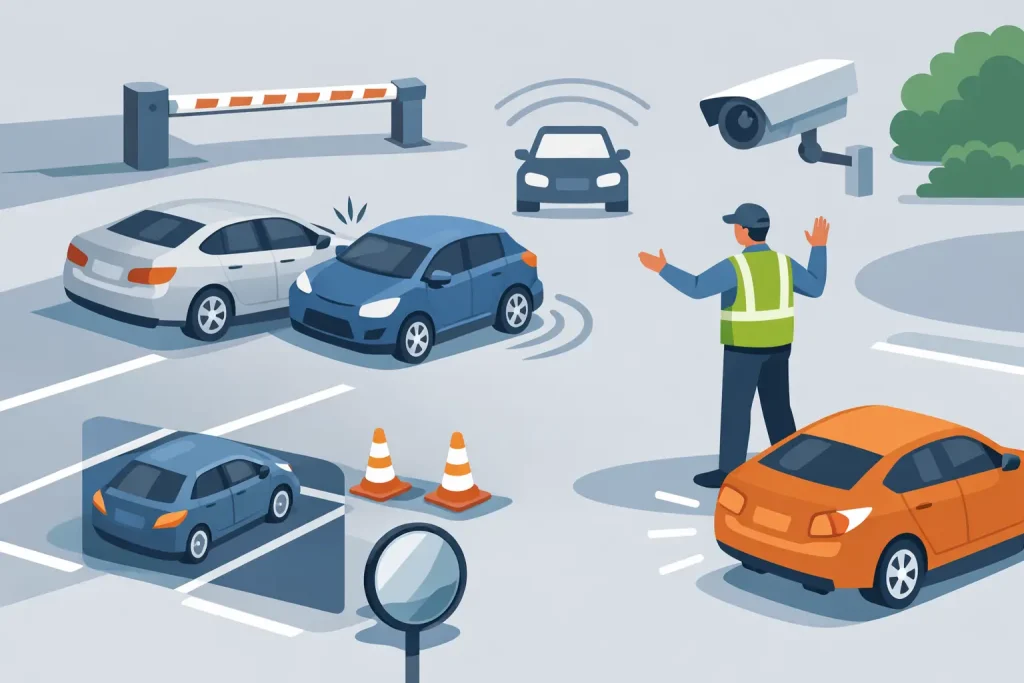
A parking lot does not need high speeds to create real liability. Most parking accidents happen in low-speed, everyday moments – backing out, cutting across lanes, missing a faded arrow, or assuming another driver sees a pedestrian. If you are responsible for a commercial property, knowing how to reduce parking accidents starts with the lot itself. The layout, markings, visibility, and traffic flow all shape driver behavior long before a claim, complaint, or near miss lands on your desk.
For property owners and managers, this is not just a maintenance issue. It affects tenant satisfaction, customer experience, insurance exposure, ADA access, and daily operations. A safer lot is usually a clearer lot. When drivers know where to go, where to stop, and who has the right of way, conflict drops fast.
How to reduce parking accidents starts with layout
Most parking lot accidents are not random. They are built into the site when circulation is confusing, stall angles do not match traffic patterns, or drivers have too many choices in too little space. Good layout planning reduces hesitation and last-second decisions, which are often the real cause of low-speed crashes.
A lot that was striped years ago may no longer fit current traffic volume, tenant mix, or delivery activity. A retail center with frequent turnover has different needs than a medical office, industrial yard, or church campus. That is why accident reduction is not just about repainting lines. Sometimes the bigger improvement comes from reworking how vehicles enter, move through, queue, and exit.
Cross-traffic is one of the biggest problems. If drivers are backing out directly into busy through lanes, or if cut-through movement is common, the layout may be creating blind conflicts. In those cases, changing stall orientation, tightening drive aisles, or adding directional control can improve safety more than any single sign.
Clear striping changes driver behavior
Drivers follow visual cues when they are easy to see and easy to trust. When striping is faded, inconsistent, or incomplete, people start making their own rules. That is when parking lots become unpredictable.
Fresh, high-contrast striping helps separate stalls from fire lanes, travel lanes, loading areas, and pedestrian paths. It also helps drivers judge spacing better, which reduces sideswipes and parking damage. In Houston-area properties, weather and wear can break down visibility faster than many owners expect, especially in high-traffic lots with constant sun exposure and turning movement.
The goal is not just to make the lot look maintained. It is to make decisions obvious. A clean center lane, readable arrows, and clearly defined no-parking zones give drivers less room to improvise.
Directional arrows and lane definition matter more than people think
One-way circulation only works when it is unmistakable. If arrows are missing, too small, or worn down, drivers may travel the wrong direction without realizing it until they meet another vehicle head-on in a tight aisle.
Defined travel lanes also reduce the tendency to drift through open pavement, especially in larger commercial sites. That drifting creates conflict with pedestrians, carts, and vehicles pulling out of stalls. Well-placed arrows and lane markings bring order to spaces that otherwise feel wide open and unregulated.
Visibility is a safety system, not a finishing touch
Many parking accidents happen because one person cannot clearly see another. That could mean poor lighting at night, overgrown landscaping at corners, or parked vehicles blocking sight lines near exits and intersections.
Improving visibility is one of the most direct ways to lower risk. Striping helps, but it should work together with the rest of the site. If shrubs are too tall near a drive aisle, if signs are hidden, or if utility boxes block views where cars cross pedestrian routes, the lot is working against itself.
Lighting deserves special attention. A lot can feel bright enough overall while still having dark pockets where backing, walking, and turning become harder to judge. Medical offices, restaurants, and retail centers often see peak activity in early morning, evening, or bad weather. If those are your busy periods, lighting is not optional window dressing. It is part of your accident prevention plan.
Pedestrian routes need to be unmistakable
Vehicle-to-vehicle damage is costly, but pedestrian incidents carry a different level of seriousness. Many commercial properties assume people will naturally walk where it is safest. In reality, most pedestrians take the shortest route available, whether or not the lot was designed for it.
Marked crosswalks, stop bars, and clear pedestrian corridors help direct foot traffic where drivers expect to see it. The key word is clear. A faint crosswalk near a storefront does not do much if the approach lane has no stop marking or if drivers are distracted by queuing traffic.
Pedestrian protection also depends on placement. Crosswalks should connect real desire paths, not idealized ones. If people consistently cut between rows or cross near building entries, that pattern needs to be addressed in the markings and site plan. Fighting user behavior rarely works. Planning for it does.
ADA areas need accuracy, not approximation
Accessible stalls and access aisles are safety features as much as compliance features. If they are improperly sized, poorly marked, or blocked by traffic flow, they create risk for both drivers and pedestrians.
This is one area where close enough is not good enough. ADA markings need to be readable, correctly located, and integrated into the lot so users can move safely from vehicle to entrance. Misplaced striping, weak signage coordination, or encroachment from adjacent parking can turn an accessible area into a daily hazard.
Signs, curbs, and wheel stops support the striping
Paint alone cannot carry the whole load. Parking safety improves when striping is backed up by physical and visual controls that reinforce the intended behavior.
That might mean curb painting at fire lanes, wheel stop placement where overhang threatens sidewalks, or stop signs at conflict points where right of way is otherwise unclear. The right combination depends on the site. Too many controls can clutter the lot and get ignored. Too few can leave important decisions up to chance.
This is where property-specific planning matters. A warehouse facility may need stronger truck and employee separation. A retail center may benefit more from pedestrian emphasis near storefronts. A medical property may need especially clear accessible routing and drop-off definition. There is no universal striping package that solves every accident problem.
Maintenance is part of how to reduce parking accidents over time
Even a well-designed lot will slide backward if markings are allowed to fade or operational changes are not reflected on the pavement. New tenants, revised traffic patterns, restriped sealcoat cycles, and added delivery activity can all create mismatch between how the lot is used and how it is marked.
That is why parking lot safety should be reviewed periodically, not only after an incident. If you are getting complaints about near misses, blocked access, confusing circulation, or vehicles parking where they should not, the pavement is already telling you something.
A practical review usually includes looking at worn striping, stacking at entrances, recurring wrong-way movement, pedestrian crossing behavior, and whether fire lanes and no-parking areas are being respected. When multiple small issues show up together, they often point to a bigger traffic-flow problem rather than isolated driver mistakes.
For active commercial properties, timing matters too. Safety improvements need to be scheduled in a way that limits disruption without delaying needed work. That is one reason many owners prefer a contractor who can walk the site, identify risk points, and phase the work in a way that fits the property’s hours and tenant needs.
The best accident reduction plan is proactive
If you wait until after a collision, claim, or injury report, you are already working from behind. The better approach is to treat the parking lot like any other operational system. If it guides people clearly, supports compliance, and reflects actual use, it will generally perform better.
That may mean a simple restripe. It may mean updating directional markings, improving pedestrian routes, or redesigning parts of the layout that no longer make sense for the property. In some cases, the lowest-cost fix is enough. In others, patching over a poor layout just keeps the same safety problems in place.
At Five Alarm Striping, that is why site planning comes first. A parking lot should not just look sharp on the day the paint dries. It should work better for everyone using it.
If you are evaluating how to reduce parking accidents at your property, start by walking the lot like a first-time visitor. The trouble spots usually show themselves quickly, and fixing them early is almost always easier than managing the fallout later.